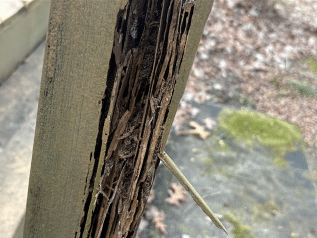
Close-up of deck post showing advanced wood rot and suspected wood-destroying insect damage.
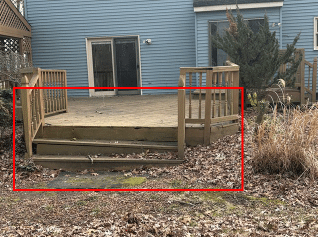
Overview of deck perimeter framing area near grade where moisture exposure can contribute to rot and structural weakening.
Deck wood rot and insect damage are two of the most common—and most dangerous—issues we find during home inspections. When moisture and wood-destroying insects combine, the damage can move from “cosmetic” to structural quickly, affecting posts, framing, and deck stability.
In this post, I’ll break down what these conditions look like in the field, why they matter, and what homeowners should do next.
Wood rot occurs when wood stays damp long enough for decay fungi to break down the fibers. Wood-destroying insects (such as termites or carpenter ants) can accelerate deterioration by tunneling or removing weakened wood. The result is often:
Loss of structural strength
Soft or hollow-sounding wood
Compromised connections and fasteners
Sagging, shifting, or instability
If structural members are affected—especially support posts, rim boards, joists, or ledger areas—the deck may no longer be safe for normal use.
The close-up photo shows a deck support/post with advanced wood deterioration consistent with wood rot and possible wood-destroying insect activity. The wood fibers appear heavily broken down with visible internal loss of material—conditions that typically indicate the member has reduced load-bearing capability.
Why it matters: When a support post is compromised, it can impact the stability of the entire structure—especially at connection points where the deck transfers weight to the ground.
The second photo highlights the lower front/perimeter deck area (shown in the red box). Areas close to grade often experience higher moisture exposure from soil contact, debris accumulation, splashback, and poor drainage. These conditions can promote rot, insect activity, and progressive framing decay, especially if wood is untreated, improperly flashed, or not adequately protected.
Why it matters: Damage in low framing areas can affect critical components like rim boards and joists, which help support the deck surface and distribute loads.
If you’re concerned about deck wood rot and insect damage, look for:
Wood that is soft, crumbly, or spongy
Holes, channels, or hollow sections
Dark staining, peeling paint, or persistent dampness
Loose railings, bouncing/springy deck boards
Sagging sections or uneven deck surface
Wood near the ground that stays wet or buried in leaves/mulch
If you see conditions like these, the best next steps are:
Limit deck use until a professional evaluation is completed (safety first).
Have a qualified deck contractor assess structural integrity and determine the scope of repair or replacement.
If insect activity is suspected, consult a licensed pest control professional for identification and treatment recommendations.
Correct contributing conditions such as:
Poor drainage and standing water
Wood-to-soil contact
Debris trapped against framing
Lack of proper flashing/protection at connections
Prevention usually comes down to moisture control and proper construction details:
Keep framing clear of soil, mulch, and piled leaves
Ensure downspouts discharge away from the deck
Maintain protective coatings and replace damaged boards early
Confirm proper flashing and water management at attachment points
Use pressure-treated lumber and corrosion-resistant hardware where required
If your deck is older, close to grade, or has visible wood deterioration, a professional inspection can help identify hidden risks before they become major repairs—or safety hazards.
If you’re buying or selling a home in South Jersey, deck conditions are a common negotiation item. Documenting issues clearly can protect both homeowners and buyers.
Can a deck still be safe with some wood rot?
Minor surface deterioration may be repairable, but rot in structural members (posts, joists, rim board, ledger area) can create serious safety risks and should be evaluated promptly.
How can I tell if it’s termites or carpenter ants?
A licensed pest professional can identify the insect type. Home inspectors can note damage patterns and conducive conditions, but confirmation typically requires further evaluation.
Should I replace the whole deck?
Not always. Some decks can be repaired by replacing damaged members and fixing moisture sources. However, widespread deterioration or unsafe structural connections can justify partial or full replacement.
“Helpful Resources”
Rutgers Termite Prevention & Control: https://njaes.rutgers.edu/fs338/
EPA Mold/Moisture Guide (PDF): https://www.epa.gov/sites/default/files/2016-10/documents/moldguide12.pdf
USDA FPL Biodeterioration of Wood (PDF): https://www.fpl.fs.usda.gov/documnts/fplgtr/fplgtr282/chapter_14_fpl_gtr282.pdf