Thermal imaging window drafts South Jersey homeowners experience are often caused by air leaks around window frames—especially in older homes, even with newly installed windows.
If you’ve installed new windows but your home still feels drafty, chilly, or unevenly heated, you’re not alone—especially in older South Jersey homes. The good news: you don’t have to guess where the problem is, and you don’t have to start pulling off trim or opening walls.
A thermal imaging (infrared) inspection is a non-invasive way to locate drafts and hidden air leaks by showing temperature differences on surfaces. In many cases, it reveals exactly where outside air is slipping in around window frames, sills, or casing—so the fix can be targeted and cost-effective.
Replacing windows is a major upgrade, but drafts can still happen when:
Gaps exist around the window frame (installation tolerances, settling, or incomplete sealing)
Insulation is missing or compressed around the window opening
Air sealing wasn’t completed properly behind trim or at the sill
The home has older framing or uneven openings, making perfect fits harder
There’s thermal bridging (cold transferring through framing/materials)
The result? A home that still feels uncomfortable—even with “brand-new” windows.
A thermal camera doesn’t “see air” directly. Instead, it detects surface temperature patterns caused by air movement and heat loss.
When cold outdoor air leaks in, it often creates:
Cool streaks along the window perimeter
Cold spots near corners and sills
Temperature bands where insulation is missing or thin
That’s why thermal imaging is so helpful: it can visually pinpoint likely draft pathways fast—without opening anything up.
This is exactly why it’s considered non-invasive:
✅ No demolition
✅ No removing trim
✅ No “trial-and-error” caulking everywhere
✅ Clear visual evidence to guide repairs
During a typical inspection, we:
Scan around windows, doors, and exterior walls with an infrared camera
Look for abnormal cold patterns that suggest air leakage or insulation gaps
Identify the most likely entry points (frame edges, casing lines, sill areas)
Recommend practical next steps—often simple air sealing or installation adjustments
Pro tip: Thermal imaging works best when there’s a solid temperature difference between inside and outside (common during South Jersey fall/winter conditions).
Thermal imaging can help you:
Improve comfort in rooms that feel cold or “drafty”
Reduce energy waste and help your HVAC run more efficiently
Confirm whether installation sealing may need attention
Prioritize repairs instead of spending money on guesses
Document issues clearly (useful when speaking with contractors)
If thermal imaging points to air leakage, the solution is usually one (or a combination) of these:
Air sealing around the window perimeter (behind trim where needed)
Low-expansion foam or proper backer rod + sealant at gaps
Sill and casing sealing to stop infiltration pathways
Correcting installation-related issues (shimming, sealing, or flashing concerns)
Targeted fixes are often far more effective than just adding more caulk on the visible surface.
We regularly perform thermal imaging inspections for homeowners throughout South Jersey, especially in older properties where comfort issues and drafts are common—even after upgrades like new windows.
If your home still feels cold near windows, or certain rooms never seem to warm up, thermal imaging can help you find the cause quickly.
Want to know exactly where drafts are coming from—without invasive work?
Contact us today to schedule a thermal imaging inspection in South Jersey and get clear, actionable answers.
Suggested caption:
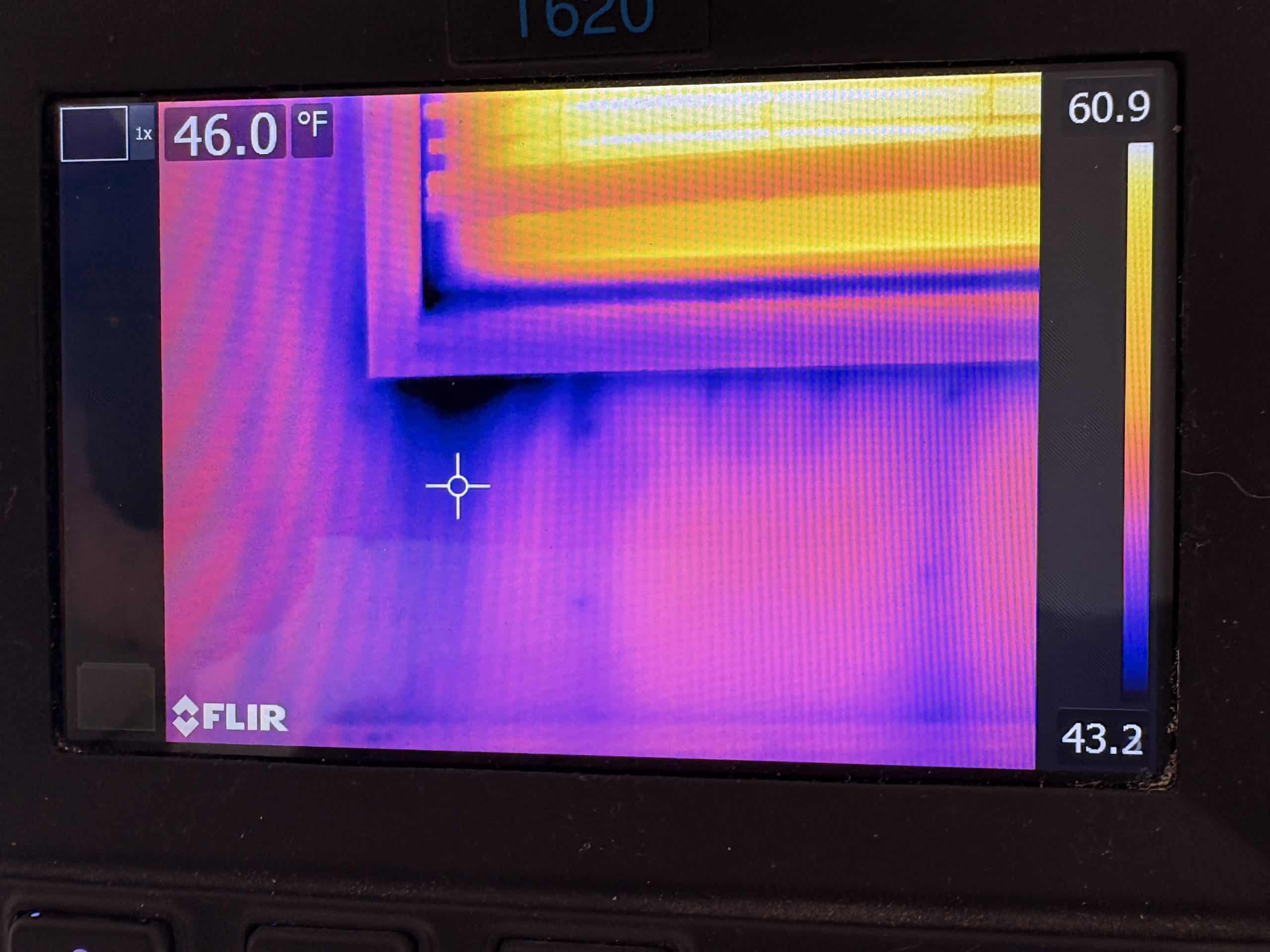
Thermal image showing cooler temperature patterns along a window area, consistent with potential air leakage/drafts around the frame.
Alt text (SEO-friendly):
Infrared thermal image of a window showing cold spots and streaks along the frame indicating possible drafts and air leakage in a South Jersey home.
A thermal camera detects temperature differences on surfaces that often show where cold air is infiltrating or where insulation is missing. It’s one of the fastest non-invasive ways to narrow down draft locations.
Drafts can come from air leaks around the window opening, incomplete sealing behind trim, settling in older framing, or insulation gaps—issues that can exist even if the window itself is new.
They’re different tools. Thermal imaging helps pinpoint locations visually, while a blower door test measures overall air leakage and can amplify leaks for easier detection. Many homes benefit from using both.
Learn More
U.S. DOE – Detecting Air Leaks (anchor: “how to detect air leaks”)
https://www.energy.gov/energysaver/detecting-air-leaks
Building Science Corporation – Air Sealing Windows (anchor: “air sealing windows best practices”)
https://buildingscience.com/documents/information-sheets/air-sealing-windows
Serving all of South Jersey and North Jersey, including Camden County (Cherry Hill, Voorhees, Haddonfield, Mullica Hill), Gloucester County, Burlington County (Moorestown), Salem County, Cumberland County, Atlantic County, Cape May County (Sea Isle City), Ocean County (Ocean City), Mercer County, Monmouth County, Middlesex County, Somerset County, Hunterdon County, Essex County, Passaic County and Bergen County.